

The Railroad Comes to Downsview
Published on

The opening of the Ontario, Simcoe, and Huron Union Railroad Company (OSHR) line from Toronto north to Barrie in 1853 ushered in an age of economic prosperity in Downsview. Originally chartered in 1849 as the Toronto, Sarnia, and Lake Huron Railway, the company’s line was to run from Toronto to a point on the southerly shore of Lake Huron—passing through Barrie along the way.
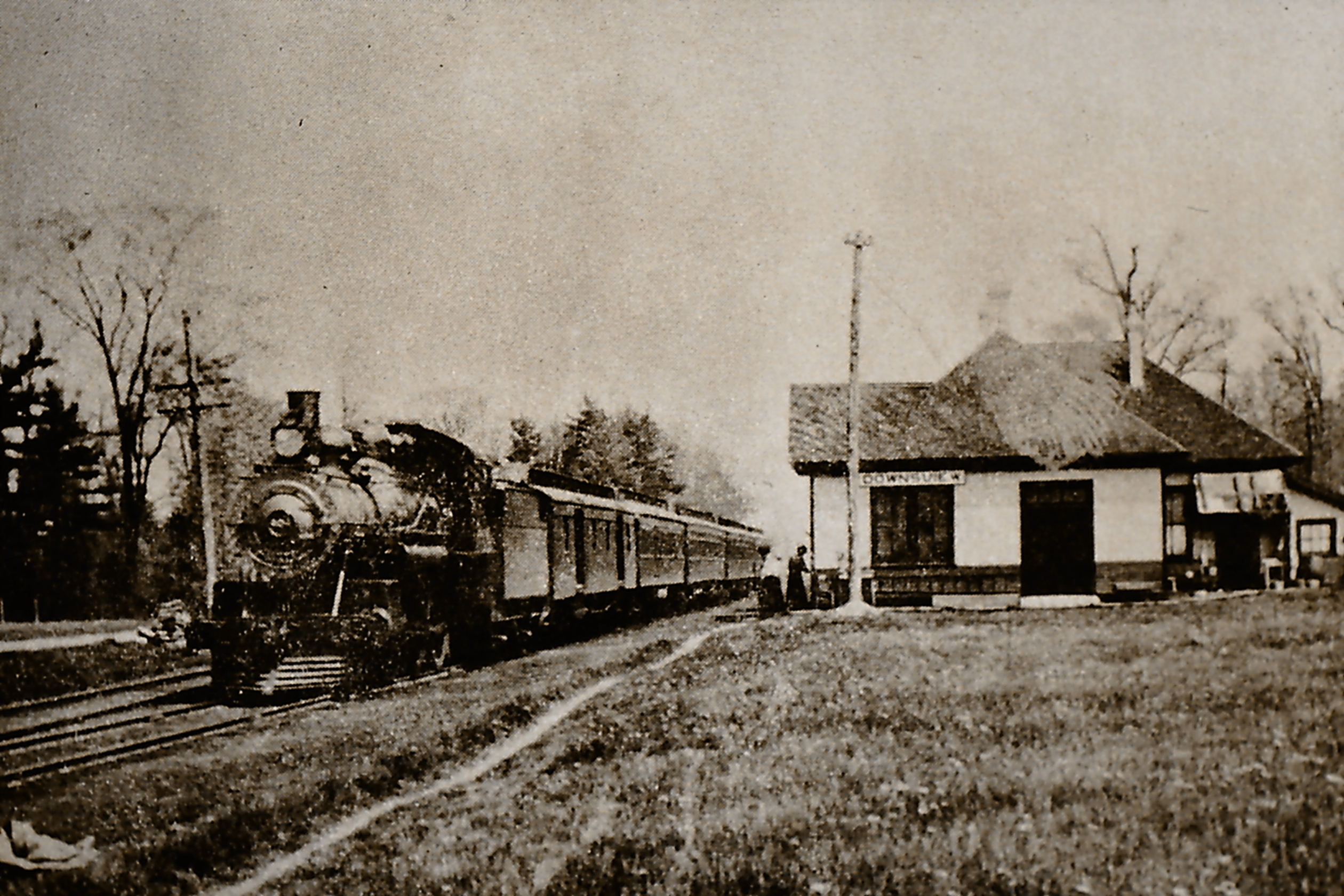
In 1853 the company changed its name to the Ontario, Simcoe, and Huron Railroad Company (OSHR) which became known as the “Oats, Straw and Hay” line owing to its primary function moving agricultural freight as well as lumber. The inaugural 48 kilometre run between Toronto and Aurora on May 16, 1848 initiated steam train service in Ontario. By 1855, the railway extended its line to Collingwood on Georgian Bay thus providing the OSHR a northern terminus and ability to control navigation on Lake Simcoe through the purchase of steamers and wharves.
The railway saw several changes in name, mergers and owners over the years 1879 to 1919:
- 1858 – the Northern Railway Company of Canada (NRC)
- 1879 – the Northern and Northwestern Railway (NNR)
- 1887 – the Grand Trunk Railway (GTR)
- 1920 – the federal government took over management of the GTR
- 1923 – the line was absorbed into the government-owned
Canadian National Railway (CNR). - 1972 – CNR opens commuter service on the line
- 1978 – commuter service taken on by VIA Rail
- 1982 – GO Transit takes on commuter service
Metrolinx currently operates the line from Toronto to Barrie with stations at Union Station, Downsview Park, York University, Rutherford, Maple, King City, Aurora, Newmarket, East Gwillimbury, Bradford, Barrie South, and Allandale Waterfront.
More Stories

Jewish Life in Downsview
There were fewer than 50,000 Jewish people living in Toronto in the 1930s when a group of visionary and optimistic community leaders got the idea to build a large Jewish cemetery on Wilson Ave, between Dufferin and Keele Streets. Most of the city’s Jewish residents lived south of Harbord St. and east of Bathurst.

Gore Vaughn Plank Road
Getting goods to market was a constant challenge for Downsview farmers in the years before Confederation. Roads were unpaved and their carts and wagons would get bogged down in the muck when it rained or during the spring thaw.